
Exhibitions
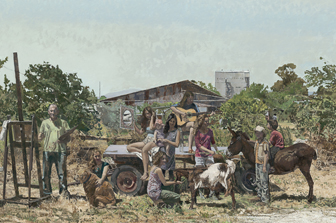
Elie Shamir
In a roundabout dialogue with Postmodernism, and against the backdrop of modernism ideas, Elie Shamir chooses to re-focus on the Human. His characters seem to come out of the fabric towards the viewers, arousing questions about Man's place in modern-day society.
Saturday, 21.01.17
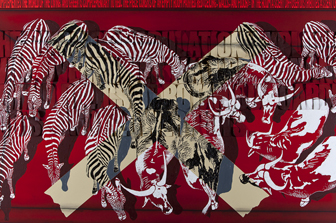
Benni Efrat
Primal Scent, 2056, 2008
The ecological discourse is one of the main issues appearing in Benni Efrat's works throughout his career. His works engage in a serious discussion regarding the future of Earth and humanity. Inspired by a sense of mission, Efrat depicts the future possibilities facing mankind, his dystopian-utopian images serving him in a futuristic-archeological history project.
Saturday, 21.01.17
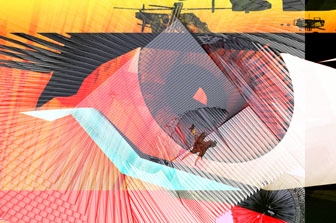
Ran Slavin
World 5, Version 2
Ran Slavin's project reflects a technologically, culturally, ethically, and aesthetically complex portrait of the present with respect to time, place, and space. Slavin works with layered digital 3-D animation, reflecting on the meaning of our disconnection from natural time. He proposes a technological space and time as a multisensory reflection of the virtual-digital age, in a simultaneous, hybrid utopian world.
Saturday, 21.01.17
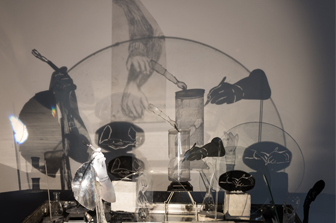
Oscillation
This exhibition is concerned with oscillation between worlds, between various opposing poles – earth and sky, the physical and the spiritual, the real and the imaginary – as an expression of the meta-modern approach. The exhibition explores the ways in which the viewer experiences the work in conditions of movement, instability, doubt, perpetual change and drift.
Saturday, 21.01.17
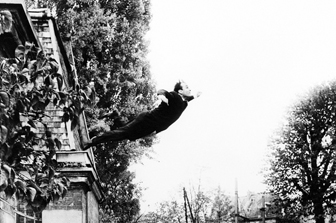
"Extremely Loud and Incredibly Close"
The day after 9/11, Richard Drew's photograph The Falling Man was published, showing a man, his head pointing downward, falling from one of the towers of the World Trade Center. The destruction of the Twin Towers as a catastrophic event that caused the collapse of a modernist monument obliges us to again question the fate of modernism in the postmodernist age. Is contemporary art gripped by a neo-utopist, or neo-catastrophic nostalgia? This question is at the center of the exhibition.
Saturday, 21.01.17
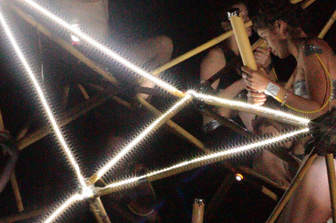
Ayelet Carmi and Meirav Heiman
Icosahedron, 2016
The icosahedron, constructed out of bamboo rods, is moved through the space of Ayelet Carmi's and Meirav Heiman's installation by seven figures pushing it by changing their posture and balance. Thereby, the artists turn the geometric-mathematical form into a vessel for the body and its actions. The vessel accumulates great tension between the concrete and definite, on the one hand, and the illusory and spontaneous, on the other hand; between the possible and the impossible.
Saturday, 21.01.17
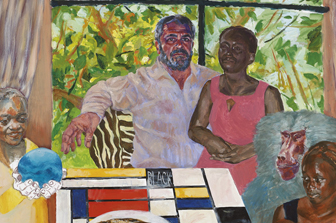
"Imagine there's no country... imaging a world with no possession..."
What will happen if John Lennon's dream of "Imagine there's no countries... Imagine no possession..." will be mutated into a Neo-Capitalistic nightmare - where Western culture will demolish the borders of all countries, until "otherness" becomes nothing but a worthless expression.
Saturday, 21.01.17
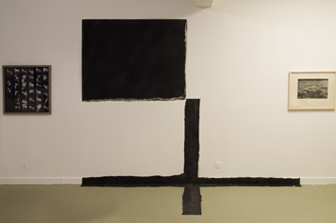
Israeli Modernism in the 1970s: from the Collection of the Haifa Museum of Art
This Exhibit seeks to explore the nature of the relationship between Post-Postmodernism stream of contemporary Israeli Art, and Israeli Art from the 1970's', where the artists were pushing to "correct" the atmosphere. Thus, we can highlight a new perspective of modern artwork, in light of transformation that have taken place at the local level, and in terms of effects resulting from the global art discourse.
Saturday, 21.01.17
The Yearning for Myth
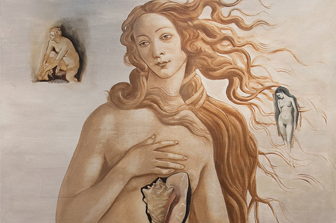
This exhibit deals with mythological themes, which appear in the artworks of many contemporary, Israeli artists. The exhibit explores the yearning of Israeli art towards creating a dialogue with the classic, Greek mythological figures and their place in Western Art. The preoccupation is examined through the presentation of artworks from the seventies, alongside artworks from the current era.
Saturday, 21.01.17
Leora Laor
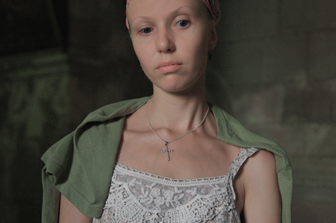
The Jerusalem Enigma, the mystery buried within the spirit of the city, the holiness as an urban riddle - these are the issues standing in the centre of Leora Laor's exhibit.
Saturday, 21.01.17
Please contact us and we will contact you as soon as possible